by: Aleksandra Godlewska, Katarzyna Pawlak, Dominik Jańczewski
Advances in Colloid and Interface Science 2026,
https://doi.org/10.1016/j.cis.2025.103738
A review paper from a collaborative project between our group and the group of Prof. Katarzyna Pawlak has just been published in Advances in Colloid and Interface Science, and it examines changes in the bacterial lipid bilayer related to antibiotic resistance.
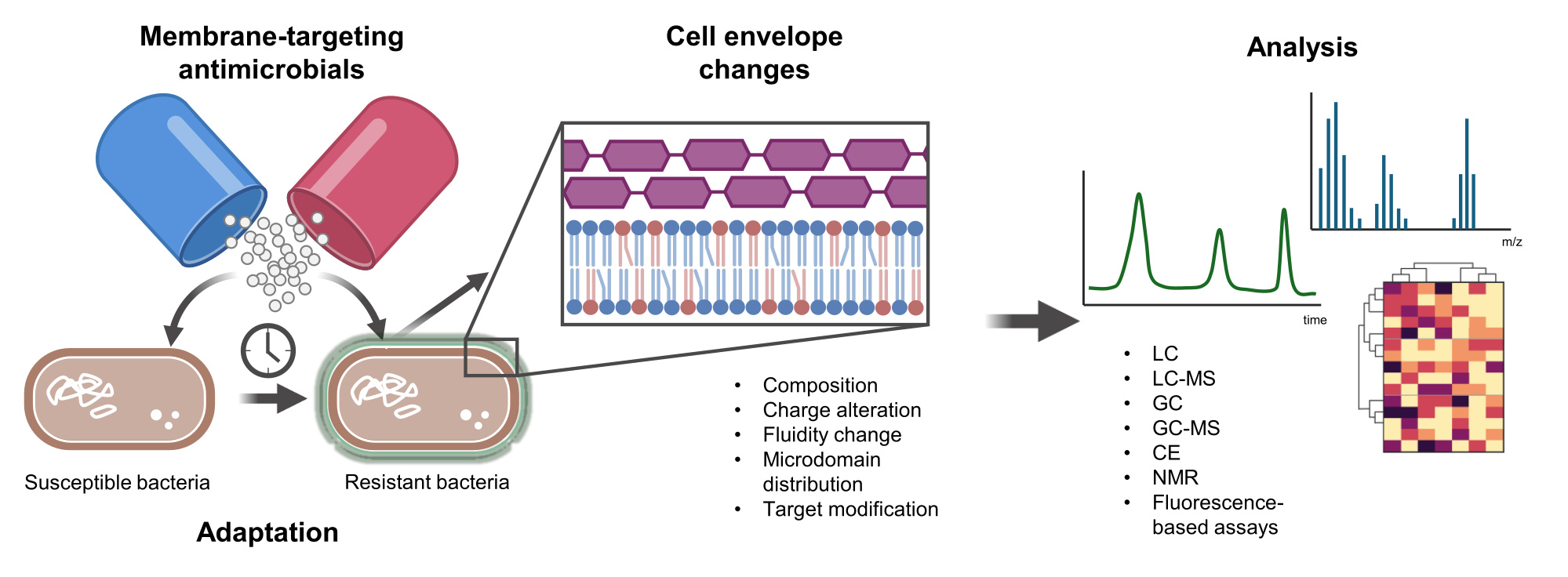
The bacterial cell membrane is a structurally essential and relatively accessible target for several antimicrobial agents, including daptomycin, polymyxins, antimicrobial peptides, and polymers. These compounds are often effective against multidrug-resistant bacteria and are considered last resort treatments. While initially considered less prone to resistance development, accumulating evidence shows that bacteria can adapt through various mechanisms – often involving alterations in membrane composition and biophysical properties. Reported resistance mechanisms include changes in phospholipid composition, lipid A structure, membrane fluidity, surface charge, and microdomain organization. Advances in analytical methodologies – including liquid and gas chromatography, capillary electrophoresis, mass spectrometry, and fluorescence-based techniques – have enabled increasingly precise characterization of these adaptations. In this review, we outline membrane remodeling strategies associated with resistance in both Gram-positive and Gram-negative bacteria and provide an overview of analytical methods commonly employed to study these changes. These insights highlight the growing relevance of membrane-level adaptations in antimicrobial resistance and underscore the need for further research using modern lipidomic and biophysical tools.