by: Rafał Jerzy Kopiasz*, Julita Pachla, Dominik Jańczewski
Advances in Colloid and Interface Science 2026,
https://doi.org/10.1016/j.cis.2026.103989
Our group published a review article in Advances in Colloid and Interface Science summarizing research on antibacterial ionenes, a class of polymers with cationic charges located within the main polymer chain.
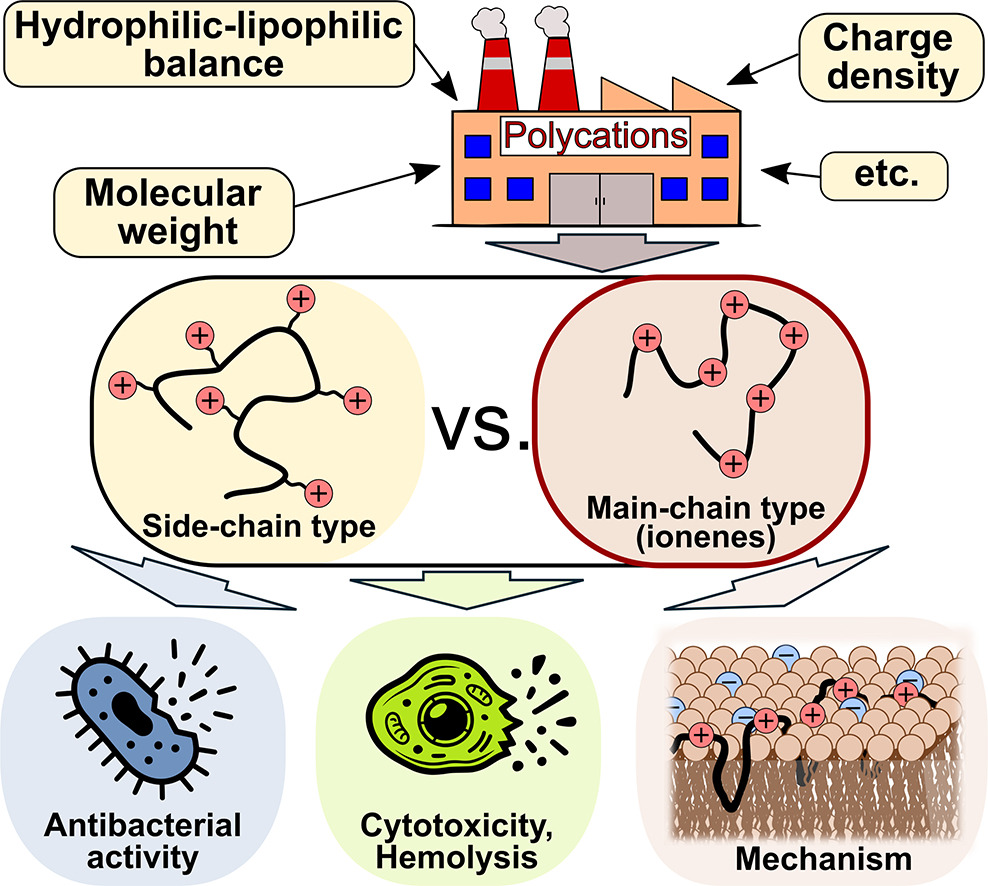
The global rise of antibacterial resistance poses a critical threat to modern medicine, underscoring the urgent need for alternatives to conventional antibiotics. Polycations have emerged as promising candidates due to their membrane-disruptive mechanisms, which reduce the likelihood of resistance development. Among them, ionenes – a unique class of polycations bearing positively charged groups within the polymer backbone – stand out for their unusual structure-activity relationship. In contrast to side-chain polycations, ionenes exhibit unique impact of their hydrophilic-lipophilic balance (HLB) on their activity: highly hydrophilic quaternary ammonium ionenes often exhibit potent antibacterial activity and efficient bacterial membrane permeabilization, while typically displaying negligible hemolytic activity. These attributes highlight ionenes as compelling prospects for next- generation antimicrobial agents. This review provides a comprehensive analysis of structure-activity relationships of ionenes, directly comparing them with side-chain polycations. We also discuss how differences in cell- envelope structures across different organisms and lipid-bilayer properties shape their mechanisms of action. Finally, we assess the clinical potential of ionenes based on available in vivo data and outline promising strategies to mitigate their potential off-target toxicity.